How to Choose the Right Fire Pump Suppliers in Qatar
A Buyer's Checklist for QCDD Compliance, Sizing, Certification & AMC Terms
Introduction
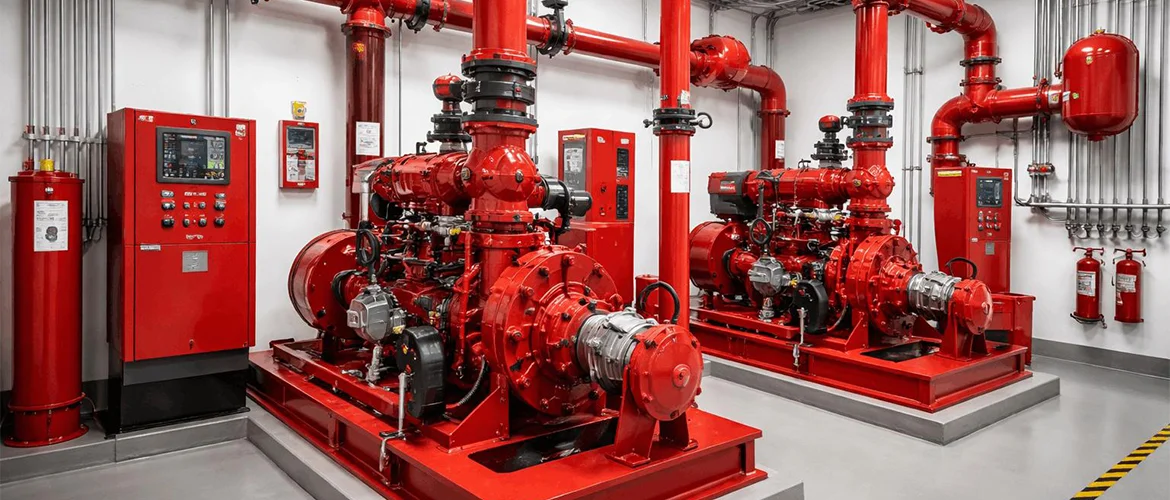
Qatar's growing skyline means every new tower, mall, warehouse, and hotel needs a dependable fire pump system behind its sprinklers and hydrants. The market includes many fire pump suppliers in Qatar, but a company that only delivers equipment is very different from a partner that understands hydraulic sizing, Qatar Civil Defence (QCDD) approvals, commissioning, and long-term maintenance.
This guide explains what to check before signing a contract, which documents to request, and which warning signs separate a compliant, reliable supplier from a risky choice.
Why the Selection Process Matters More Than the Price Tag
Comparing suppliers only by quote price can be costly. If a fire pump is undersized, installed incorrectly, or supplied without the required QCDD documentation, the result may be rework, failed inspections, and a system that does not perform when it is needed most. A careful selection process protects the project throughout approval, installation, and operation.
The Key Principle
Buy an engineered, approved, and maintainable fire pump system—not simply a pump model at the lowest price.
Confirm QCDD Approval & Documentation Capability
A fire pump supplier in Qatar should support the QCDD approval process for the complete project, not stop after handing over the equipment.
| What to Ask | Why It Matters |
|---|---|
| Do you provide QCDD-approved shop drawings before procurement? | Equipment should be ordered only after the drawings are approved. |
| Can you supply material submittals and datasheets in the format QCDD expects? | Complete, correctly formatted submittals help prevent inspection delays. |
| Have you completed QCDD-approved fire pump installations before? | A relevant track record reduces the risk of rejected inspections. |
| Who manages the final QCDD inspection and sign-off? | This confirms whether support continues through completion or ends at delivery. |
Ask for Hydraulic Sizing Calculations
A standard pump size is not a substitute for calculations based on the specific building. The supplier should size the system using:
Demand Area
The hydraulically most demanding sprinkler or hose-stream area.
Flow & Pressure
The required flow rate in GPM and pressure in PSI at that point.
System Losses
Elevation and friction losses throughout the piping network.
Water Source
The characteristics of the main, underground tank, or reservoir.
Ask This Directly
“Can you share the hydraulic calculation sheet that justifies this pump's rated flow and pressure for my building?” If the supplier cannot provide it, the selection is a guess rather than an engineered decision.
Check the Equipment Certification
The supplier's credentials matter, but the pump, controller, and system components also need the right approvals and compatibility.
- UL listing or FM approval: Look for recognised third-party certification on the pump and controller.
- NFPA 20 compliance: The system should follow the standard for stationary fire pumps, alongside local QCDD requirements.
- Controller compatibility: The controller must match the pump's electrical characteristics and support the required operation and alarm signalling.
Understand Testing & Commissioning
Installation is not the finish line. Proper commissioning establishes the performance baseline for future inspection, testing, and maintenance under NFPA 25.
- Confirm that a full-flow test will be completed at commissioning and witnessed by QCDD or an authorised inspector.
- Ask whether the facilities team will be trained on weekly churn or no-flow test protocols for diesel engines.
- Check whether annual flow testing is included in year one and obtain the future cost in writing.
- List the test certificates, pump curves, manuals, and logs that will be supplied at handover.
Compare Warranty, Spare Parts & Local Support
Fire pumps can remain in service for decades, so the supplier relationship must continue beyond installation.
| Question | Red Flag Answer |
|---|---|
| What is the warranty period on the pump and controller? | Warranty terms are vague or only given verbally. |
| Are seals, bearings, impellers, and other common parts stocked in Qatar? | All parts will be ordered from overseas after a failure. |
| Is a QCDD-compliant Annual Maintenance Contract available? | There is no structured AMC offering. |
| Who handles emergency breakdowns, and what is the response time? | No responsible contact or written response time is defined. |
Common Supplier Selection Mistakes
- Choosing on price alone without comparing sizing and certification.
- Ordering equipment before QCDD shop drawing approval.
- Not confirming local spare-parts availability.
- Overlooking controller integration with the fire alarm and BMS.
- Assuming the installation team also handles maintenance.
Why RGIFIRE Fits the Checklist
RGIFIRE has supplied and installed fire pump systems across Qatar's commercial, industrial, and residential sectors for over a decade. Projects begin with building-specific hydraulic calculations and QCDD-approved shop drawings—not a generic pump selection.
Our team works with globally recognised certified brands, manages QCDD submittals and inspections, and supports installations with Annual Maintenance Contracts and locally available spare parts.
Not Sure Whether Your Current Quote Stacks Up?
Send RGIFIRE your project details. Our team can review the proposed sizing, certification, and QCDD documentation so you understand exactly what you are signing up for.
Contact RGIFIRE